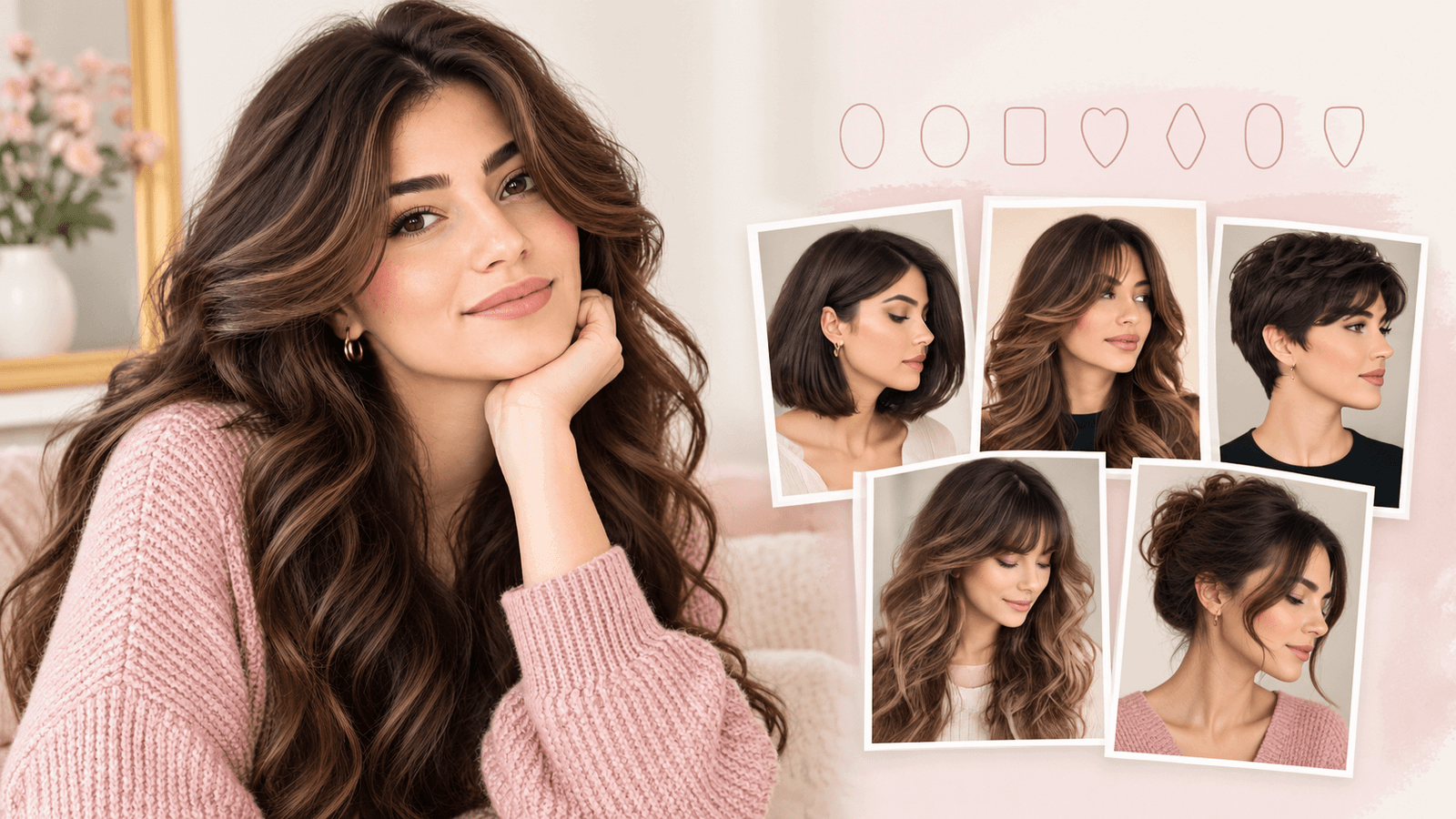
Knowing how to choose a haircut that actually works for you comes down to more than just picking a style you like in a photo. A cut can look incredible on someone else, you bring the same photo to your stylist, and somehow it just doesn’t land the same way on you. That’s not always the stylist’s fault, and it’s not always yours either.
Your face shape, your natural hair texture, how thick or fine your hair is, your current length, and your styling routine all change how the exact same haircut looks once it’s actually on your head.
The good news is you don’t have to guess your way through it. There’s a specific process stylists actually use, measurements, not impressions, and you can run it yourself in a few minutes. Want the short version? Our what hairstyle suits me quiz runs the same checks in about two minutes.
Find Your Face Shape First
Here’s something most people don’t realize: hairstylists don’t eyeball your face shape, they measure it. Four numbers tell them everything they need, how long your face is, and how wide it is at the forehead, the cheekbones, and the jaw. Add in whether your jawline curves softly or turns a clear angle at the corner, and that’s genuinely the whole formula behind why a round face reads differently from a square one, or why oval and oblong get confused so often.
Most of us never do this math. We just look in the mirror and guess, which is exactly how someone ends up convinced they’re “round” for ten years when they’re actually oblong.
Think of your result as a starting point, not a verdict. Your natural hair has just as much say in this, which is where things get interesting next.
Stop guessing. Measure it properly instead.
Grab a tape measure, take four quick measurements, and get the exact shape, plus the specific cuts and bangs worth asking for.
Try the Face Shape Calculator →How to Actually Measure Your Face
If you’re going to do this, do it right. A couple of inches of hair hanging over your forehead, or measuring your jaw at the chin instead of under your ears, is enough to send you to a completely wrong shape.
Pull your hair back completely and stand straight in front of a mirror. A soft tape measure works best, the fabric kind used for sewing, though a piece of string held against a ruler afterward does the job too.

Face length runs from your hairline straight down the middle to the tip of your chin. Forehead width is across the widest part, roughly halfway between your eyebrows and hairline. Cheekbone width goes from the top of one cheekbone, just under the outer corner of your eye, across to the other. And jaw width is just below one ear to just below the other, at the widest point, not at your chin.
Stick to one unit for all four, inches or centimeters, it doesn’t matter which, since the shape comes from how the numbers compare to each other, not their actual size.
What the Seven Face Shapes Actually Look Like
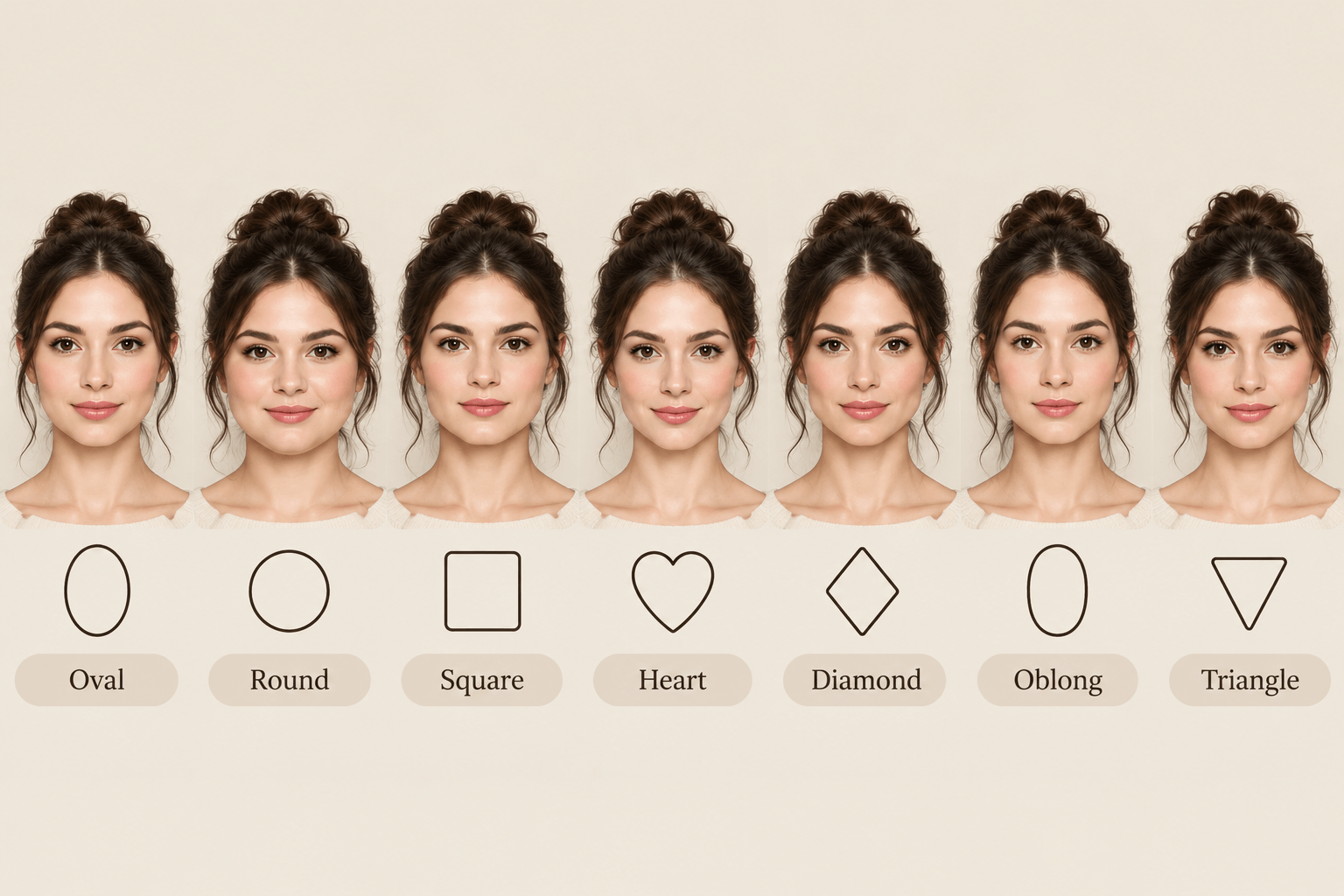
Once you have your four measurements, you can start to see which face shape looks closest to yours.
Oval: The face is longer than it is wide, with the cheekbones slightly wider than the forehead and jaw. The jawline is usually soft and rounded.
Round: The length and width are fairly similar. The cheeks tend to look fuller, and the jawline has a smooth, curved shape.
Square: Like a round face, the length and width are often close. The main difference is the jaw, which has more defined corners.
Heart: The forehead is usually the widest part of the face, while the lower face gets narrower toward a pointed or narrow chin.
Diamond: The cheekbones stand out as the widest part. The forehead and jaw are both narrower, giving the face a more defined shape.
Oblong: The face is noticeably longer than it is wide. The forehead, cheekbones, and jaw are often similar in width, with more length through the middle of the face.
Triangle: The jaw is the widest part of the face, while the forehead is narrower. The cheekbones usually fall somewhere between the two.
The One Rule Behind Every Recommendation
Face shape can help explain why some haircuts feel more balanced than others. The basic idea is to use the haircut to create balance rather than copy a certain style just because it is linked to your face shape.
For a round face, styles with some height at the top can make the face look longer. Layers that start below the chin can also help. With an oblong face, adding width can create a more balanced look. A blunt lob or soft bangs can make the face appear a little shorter.
For a heart-shaped face, some fullness around the jaw can balance a wider forehead. A chin-length bob is one simple way to do this. A triangle face often benefits from more volume around the temples and upper sides, which can help balance a wider jaw.
Bangs play by the same rule. Curtain bangs work on almost everyone because they add width at the forehead while softening the cheek, both at once. Blunt, heavy bangs shorten the face, great for oblong, a bit much for round. If you want the full breakdown, our guide to bangs for round faces goes through it style by style.
How to Choose a Haircut That Works With Your Hair
Your natural hair texture matters just as much as your face shape when choosing a haircut. A style that looks great on straight hair may need more work on wavy or curly hair.
Before picking a cut, look at how your hair behaves when you leave it alone. Check whether it dries straight, forms waves, curls up, feels thick, or looks fine. This gives you a better idea of which cuts will work with your hair instead of fighting against it.
Curious what your hair actually does on its own?
Answer 8 quick questions and get your exact type on the 1A to 4C scale, your density, a wash-day routine, and the cut worth asking for. Takes about two minutes.
Take the Hair Type Quiz →Getting an Accurate Hair Type Result
Most wrong results come down to timing. If your hair’s been diffused, brushed, or slept on, what you’re looking at is the style, not the hair underneath it. Damaged, bleached ends lie too, they’re usually loosened from their real pattern. And most people’s hair actually carries two patterns at once, curlier underneath, calmer up top, which throws people off even more.
The fix: wash it, put nothing on it, and let it air dry completely untouched. Once it’s dry, check your mid-lengths specifically, not your roots, which oil weighs down, and not your ends, almost always the most damaged part. Whatever pattern covers the most of your head is your type. Treat anything underneath as a bonus to factor in separately.
What the Four Hair Type Families Mean
The 1A to 4C system is used to describe the natural pattern of your hair. There are four main groups, and each group has three smaller types.
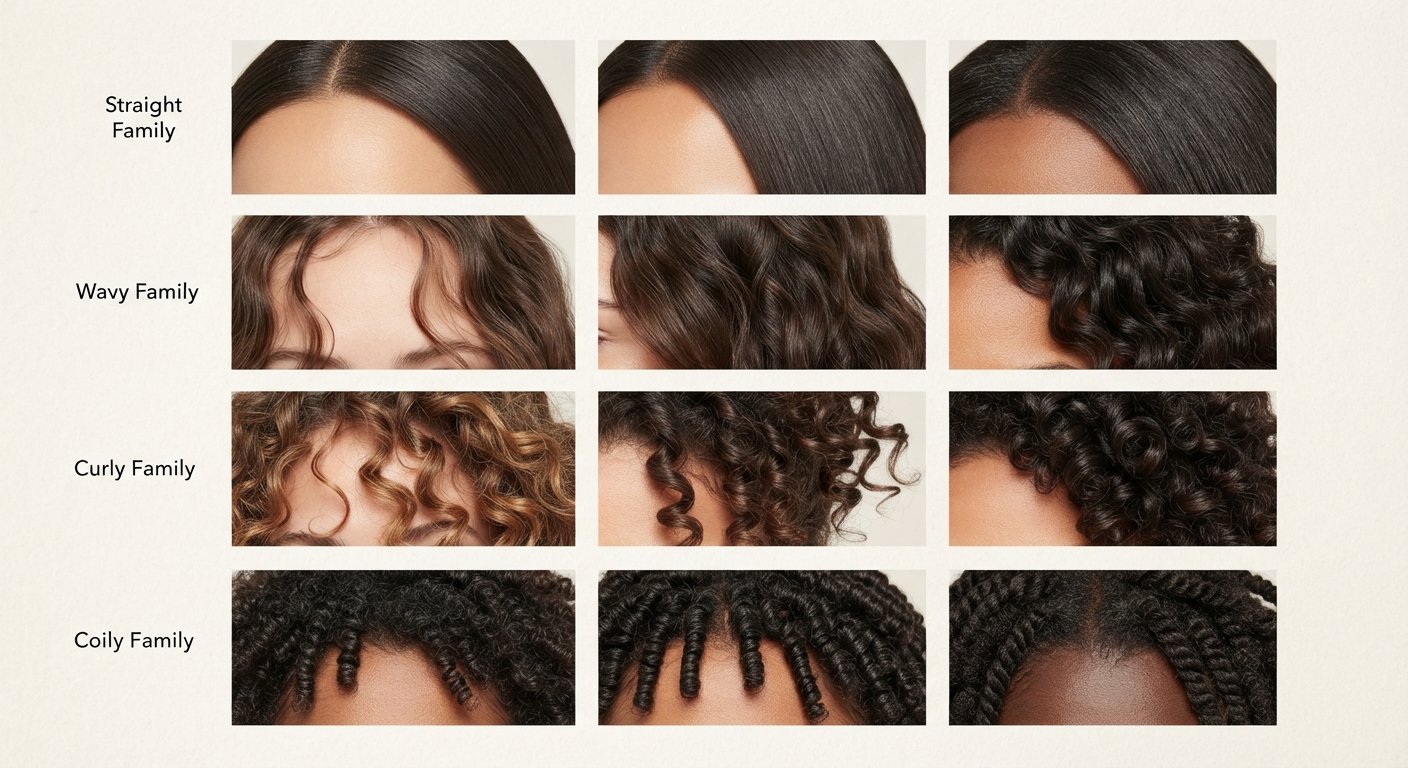
Type 1: Straight Hair
Straight hair has little or no natural curl.
- 1A: Very fine and straight, with little body.
- 1B: Straight with a little more volume and a slight bend at the ends.
- 1C: Thicker and coarser than the other straight types. It may form a slight wave in humid weather.
Type 2: Wavy Hair
Wavy hair forms a loose S pattern. Some waves are very soft, while others are more noticeable.
- 2A: Fine, loose waves that can look almost straight when brushed.
- 2B: More visible S-shaped waves, often with some frizz.
- 2C: Strong waves that can begin close to the roots and may form a few loose curls.
Type 3: Curly Hair
Curly hair forms clear curls or spirals. The curls can range from loose to fairly tight.
- 3A: Large, loose curls with plenty of movement.
- 3B: Smaller curls that are more defined and springy.
- 3C: Tight curls that sit closer together and have more volume.
Type 4: Coily Hair
Coily hair has very tight curls or bends and can shrink quite a bit when it dries.
- 4A: Small, clearly defined coils.
- 4B: Hair bends into sharper shapes instead of forming round curls.
- 4C: Very tight coils with less visible curl definition and noticeable shrinkage.
The letters are not a ranking system. A 2A texture is not better or worse than 3A, and 4C hair is not a more difficult version of another type. Each texture has its own needs and works best with the right care.
Two People, Same Type, Different Hair
Here’s the part most people skip entirely: two people can test as the exact same hair type and still get completely different results from the same cut. Type tells you the shape. It doesn’t tell you how much hair you actually have, which is where density comes in.
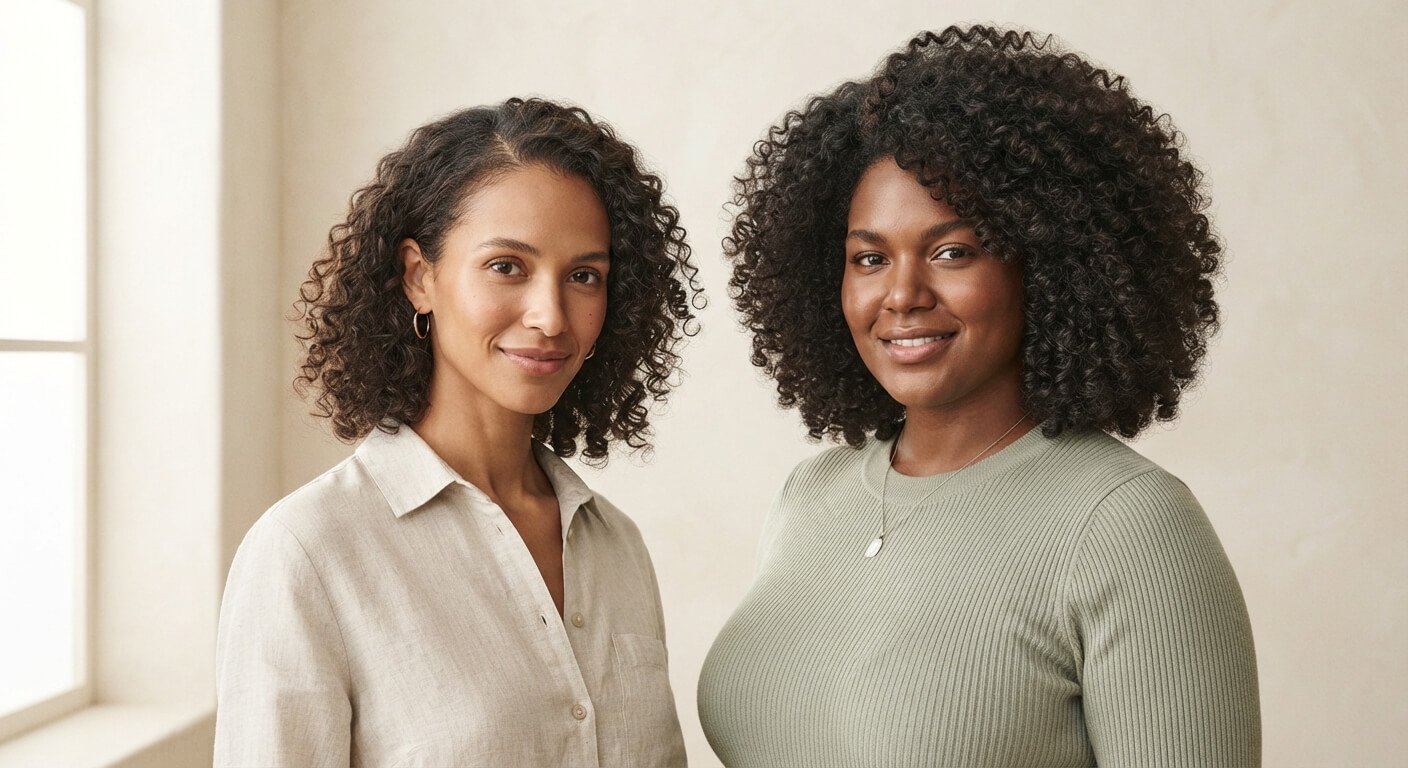
Two people can both land on 3B and still need very different amounts of product and very different layering, simply because one of them has roughly twice as much hair as the other. That’s exactly why the Hair Type Quiz hands back your density alongside your type instead of leaving you to figure that part out on your own. Both pieces together are what actually tell your stylist how to approach the cut, not just what shape to aim for.
A Few Mistakes Worth Avoiding
A few small mistakes can make your face shape or hair type seem different from what it really is. Keep these points in mind.
- Measuring over your hair. Pull your hair back before taking your face measurements. Loose hair can make your face look wider than it actually is.
- Measuring the jaw in the wrong place. For the jaw measurement, measure from below one ear to below the other. Do not measure straight across the chin.
- Treating your face shape as a strict rule. Your face shape is a useful starting point, not a list of haircuts you must follow. Other features and your personal style matter too.
- Checking hair after styling. Hair that has been brushed, straightened, curled, or slept on may not show its natural pattern. Check your hair when it is clean and left to dry naturally.
- Judging damaged ends as your true texture. Bleached or damaged ends can look looser than the rest of your hair. Look at the healthier sections near your roots as well.
- Guessing your hair type from family members. Your hair does not have to match your parents or siblings. Even people in the same family can have very different hair patterns.
- Thinking a higher hair type is better. The hair typing system is only a way to describe texture and pattern. One type is not better than another.
Measure carefully, check your natural hair, and use both results as a guide. If you love a haircut that does not seem like an obvious match, ask your stylist how it could be adjusted for you. Not sure what to tip after a big change? Our hair salon tip calculator works it out in seconds.
How Much Styling Are You Actually Willing to Do
A cut can look stunning the moment you leave the salon chair and turn into a daily fight once you’re trying to recreate it yourself.
Some styles need regular blow-drying, heat tools, or frequent trims just to hold their shape. If your actual routine is wash-and-go, a high-maintenance cut is probably going to frustrate you more than it flatters you. If you genuinely enjoy styling, you’ve got more room to play. A good haircut fits your real mornings, not just the one good hour in the stylist’s chair.
What to Tell Your Hairstylist
A reference photo is helpful, but the same haircut may look different on you because your face shape, hair texture, and hair density are not the same as the person in the picture.
Tell your stylist which parts of the haircut you like. You might want the same length but softer layers, or you may like the bangs but want them long enough to grow out easily.
You can also mention what you want to keep or change. For example, if your hair feels thin at the ends, let your stylist know that you want to keep as much fullness as possible.
Take your face shape and hair type results with you as well. They give your stylist more information to work with when adjusting the cut for you.
Keep reading: Curtain Bangs: The Complete Guide Plus 20 Styles to Try, How to Style a Butterfly Haircut for Every Hair Type and Haircuts for Thick Hair That Make Hair Easier to Manage. To see where each length falls, use our hair length chart.
Final Thoughts
The best haircut was never really “whichever one matches your face shape chart. Measure your face, run the Face Shape Calculator, then run the Hair Type Quiz, and the overlap between those two results gets you an actual answer instead of a guess.
So instead of asking, Which haircut is perfect for my face, try: Which version of this haircut actually works for my face shape and my hair? That’s the question that gets you a cut you’ll still love wearing in six months.